
 Italiano
 Español
 Français
 Deutsch
 Nederlands
 Português do Brasil
 Pусский
 日本語
日本語 简体中文
简体中文 한국어
한국어

Conservation Centre
The Grand Egyptian Museum Conservation Centre is currently one of the largest and most advanced heritage conservation facilities in its efforts to preserve all of Egypt's archaeological treasures for future generations.
Located immediately to the west of the main part of the Museum Centre and connected by a secure underground passage, it is fully equipped with state-of-the-art laboratories, climate-controlled storage facilities and highly qualified conservators, scientists and scholars. Here a wide range of artefacts - from large stone statues to fine wooden coffins, mummies, textiles and papyri - are studied, treated and documented using the best scientific techniques available.
In addition to its core mission of conservation and restoration, the GEM-CC is a dynamic research and training facility with strong international links. It houses nineteen laboratories, including preventive conservation facilities, scientific laboratories and a digital documentation unit, to carry out wide-ranging projects to study the material, technical and environmental conditions essential for the long-term conservation of artefacts. Working with organisations such as JICA, and in collaboration with universities and museums around the world, it will contribute to the development of international best practice in conservation science, making the Grand Egyptian Museum a role model not only for visitors, but also for professionals involved in the protection of cultural heritage in the Middle East and beyond.
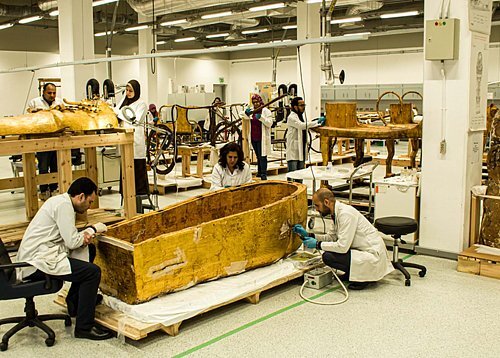
About the Conservation Centre
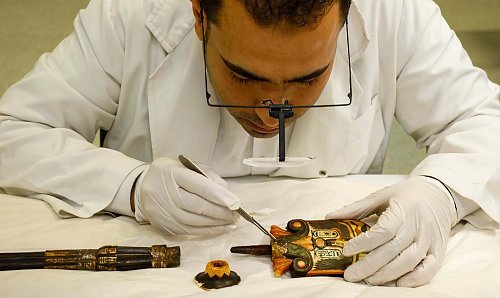
The Grand Egyptian Museum Conservation Centre (GEM-CC) is one of the largest and most comprehensive international conservation centres in the world. Built on an area of 32,000 square metres, the GEM-CC is a regional institute in the field of artefact conservation and preservation, continuously developing new treatments and methodologies to adapt to the rapidly changing world of conservation. It was inaugurated in 2010 during Phase II of the GEM project. In addition to its role of conserving and preparing the artefacts selected for display at GEM, the GEM-CC is a research institute for the development of conservation sciences and applications. It not only provides technical assistance in the field of conservation to related agencies and institutions, but also contributes to the capacity building of conservation professionals in Egypt and abroad. The multidisciplinary staff of the GEM-CC is expertly trained in the treatment of paper, textiles, wall paintings, wood, rare books, papyrus, mummies, human remains, ceramics, glass, faience and sculpture.
The GEM-CC is located on the west side of the GEM and is connected to the main museum building by a 200-metre-long tunnel. It consists of 19 specialised laboratories in addition to six well-equipped storerooms.
The laboratories at GEM-CC are divided into three categories (Conservation Labs, Preventive Conservation Labs and Documentation Lab) to cover all aspects of conservation, whether it is remedial, preventive or conservation science.
Conservation Labs
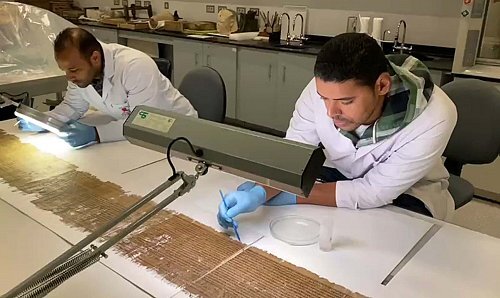
GEM-CC consists of six specialised conservation laboratories focusing on remedial conservation, categorised according to the material type of the artefacts. These include an organic laboratory, a mummies and human remains laboratory, an inorganic laboratory, a wood conservation laboratory, a stone and murals laboratory and a heavy artefacts area. The conservation laboratories are equipped with state-of-the-art facilities, tools and instruments designed to support conservation efforts, address all facets of occupational health and safety, and ensure adequate ventilation and lighting systems.
The spacious laboratories, each measuring approximately 580 m², provide ample space for conservation tasks, and each laboratory is equipped with a holding room designated for temporary storage of artefacts.
The conservation laboratories are equipped with state-of-the-art facilities, tools and instruments designed to support conservation efforts, address all facets of occupational health and safety, and ensure adequate ventilation and lighting systems.
Preventive Conservation Labs
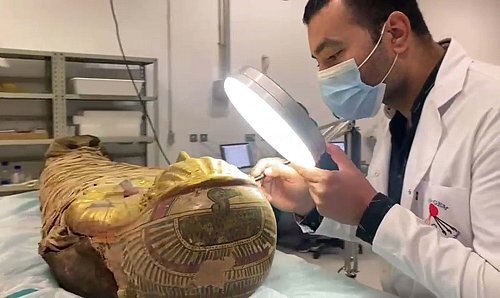
GEM-CC established four preventive conservation labs. The purpose of these labs is to formulate and implement preventive conservation programmes at the GEM in order to ensure the short and long term preservation of the GEM collections in the storerooms, labs and galleries.
Preventive conservators undertake ongoing, comprehensive procedures for protecting the collections, whether on display, in storage or in a lab in order to prevent their deterioration and delay their natural ageing process. Preventive conservation labs are packing/unpacking and storage area, inert gases fumigation lab, anoxia lab, and environmental management unit.
These labs are also equipped with the state-of-the-art facilities, apparatus and equipment, facilitating the optimal implementation of preventive conservation programmes, such as humidifier/dehumidifiers, inert-gas tanks and cylinders, devices for monitoring and recording temperature, relative humidity, light and air pollution, dust, wind direction and velocity, and light control devices, a built-in chamber for anoxic treatments, airtight tents for low-oxygen treatments, and special devices and equipment to safely handle and store the artefacts.
GEM-CC Policy
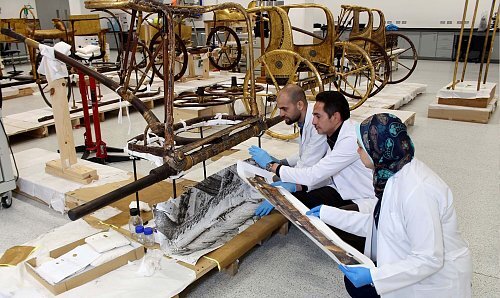
A specific policy has been established for the treatments carried out in GEM-CC’s laboratories, which is in line with international ethical conservation codes and practice guidelines, while at the same time demonstrating deep respect for the uniqueness of Egyptian artefacts.
This policy is based on three fundamental principles: the first principle is Minimum Intervention, which guarantees the stabilisation of the artefact material(s) (state of conservation) and mitigates further damage without the excessive use of chemicals; the second principle is Preventive Conservation, which involves the careful management of the environment surrounding the artefacts in order to prevent or halt the causes of deterioration; and the third principle is Non-Destructive Analysis, which seeks to reveal critical information about the artefact and its degradation products in order to support conservation initiatives.